


Giant Himalayan Honey Bee: Altitude Foraging
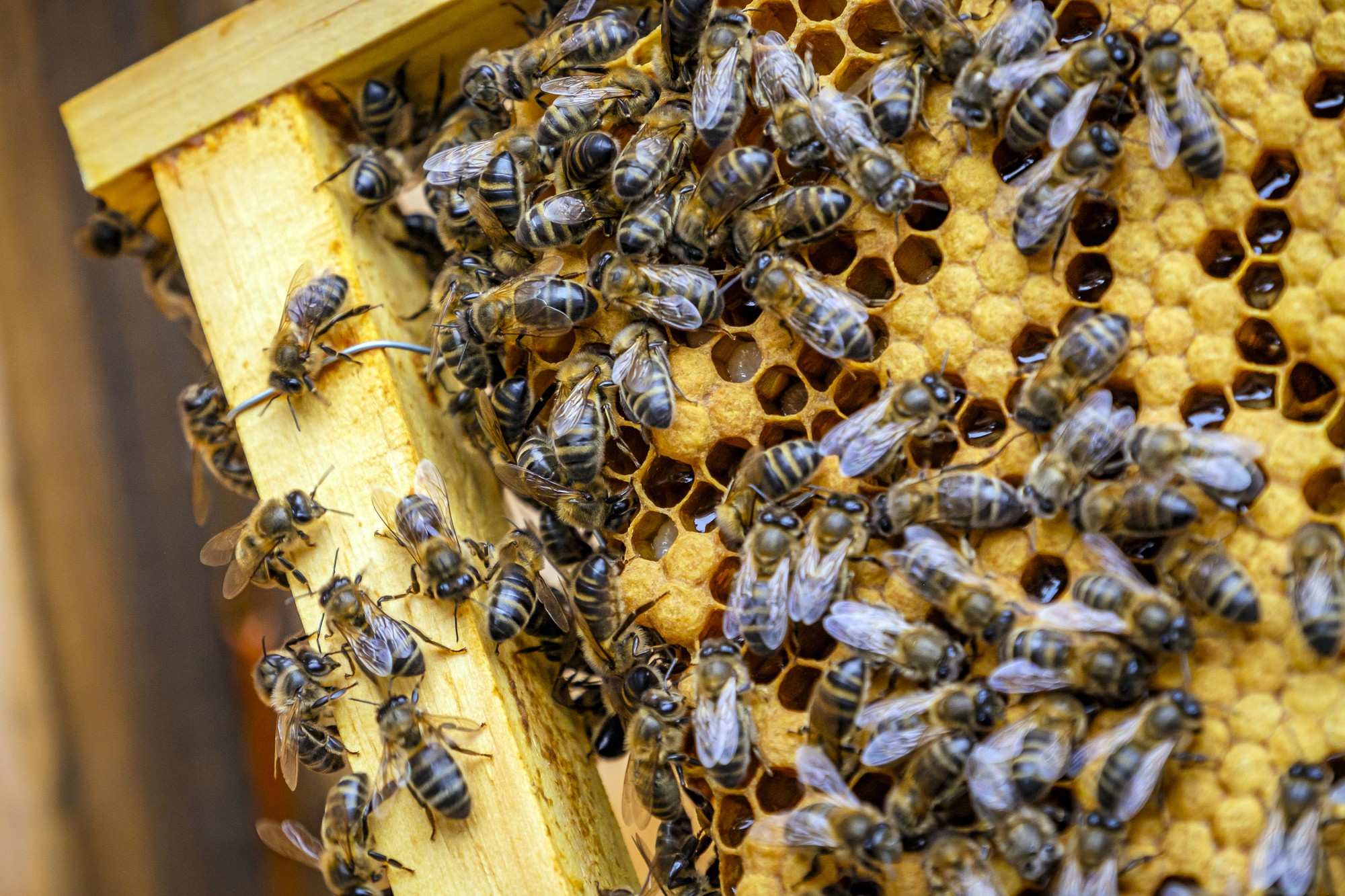
|
Summary: The giant Himalayan honey bee, Apis laboriosa, builds single-comb nests on sheer cliff faces and forages higher than almost any other insect on earth. This article covers how it navigates sparse alpine terrain, which treeline plants fuel its foraging runs, and how those plants shape the chemistry of cliff honey. It also outlines the ecological and cultural stakes of keeping this species intact. |
Table of Contents
- Species Overview & Highland Niche
- Altitude Foraging Behaviour & Navigation Science
- Treeline Flora and Honey Chemistry
- Ecological & Cultural Significance of Cliff Honey
- Conclusion
- FAQs
The largest honey bee on earth, Apis laboriosa, clings to cliff faces above Nepal's treeline and collects nectar where most other bees cannot survive. The giant Himalayan honey bee is built for extremes: thin air, strong UV radiation, and temperatures that swing sharply between day and night.
This article explains how it navigates, what it collects, and why both matter for mountain ecosystems and the rare honey they produce.
Species Overview & Highland Niche
Apis laboriosa is the world's largest honey bee, reaching up to 3.0 cm (1.2 in) in length. It was confirmed as a full species in 2020, distinct from its close relative Apis dorsata, after researchers observed the two species co-existing at multiple sites with no sign of interbreeding.
Colonies nest between 2,500 and 3,000 meters primarily, preferring the southwestern faces of vertical cliff overhangs. Himalayan treeline bees like A. laboriosa select these exposures deliberately: southwest-facing rock collects afternoon solar warmth, reducing the energy cost of thermoregulation. Foragers extend their range up to 4,100 meters (13,500 ft), well above the treeline, where low atmospheric pressure, intense UV exposure, and persistent wind create a demanding operating environment.
Nest placement also tracks water availability. Studies show that nesting sites of Himalayan treeline bees are typically 20 to 200 meters from a major water source, and colonies favor lighter-colored rock faces. A single nest can contain up to 60 kg (130 lb) of honey, making each cliff colony a substantial nutritional and cultural resource.
|
Did You Know? Apis laboriosa doesn’t just live high in the Himalayas—it operates even higher. While most colonies nest between 2,500 and 3,000 meters, these bees can forage up to 4,100 meters, braving thin air, strong winds, and intense UV exposure in one of the harshest environments any honey bee inhabits. |
Altitude Foraging Behaviour & Navigation Science
Apis laboriosa forages exclusively during daylight hours. Its open cliff nests expose the comb directly to sunlight, and research found that its waggle dances contain no acoustic signals. Studies also concluded that acoustic location signalling is an adaptation for species that dance under low light. A. laboriosa, dancing in full sun, communicates direction and distance through movement alone.
This silent dance is how wild bee navigation works at altitude: the colony reads solar position and encodes steep vertical distances that would be irrelevant to lowland species. Above the treeline, landmarks are sparse, and terrain drops away sharply. The bee's sun-compass orientation compensates for this, using the angle of sunlight to maintain consistent bearing across open ridgelines.
The wingbeat frequency of A. laboriosa is documented as 133 Hz, lower than those of A. cerana (290 Hz) and A. dorsata (100 Hz). This is a species-level morphological trait, not a confirmed altitude-specific aerodynamic adjustment. No peer-reviewed study directly measuring wingbeat adjustment in response to thin-air conditions at altitude was located, so that specific claim is omitted here.
These navigational and physical traits allow altitude-foraging bees to exploit nectar sources that no managed honeybee species can reliably reach. What they collect in those ranges gives cliff honey its distinctive chemistry.
Treeline Flora and Honey Chemistry
The primary nectar sources for A. laboriosa shift by season and elevation. Spring foraging draws heavily on rhododendron species; autumn foraging shifts toward buckwheat and other late-blooming flora. Each plant contributes different compounds to the honey.
|
Floral source |
Altitude (m) |
Signature compound |
Sensory note |
|---|---|---|---|
|
Rhododendron arboreum |
2,800–4,000 |
Grayanotoxin (diterpenoid) |
Bitter, medicinal |
|
Rhododendron campanulatum |
2,800–4,000 |
Grayanotoxin (diterpenoid) |
Bitter, numbing |
|
Chestnut (Castanea spp.) |
1,500–2,500 |
Tannins |
Dark, astringent |
|
Buckwheat |
1,200–2,800 |
Rutin, dark phenolics |
Earthy, pungent |
Rhododendron-dominant harvests carry the highest grayanotoxin load and correspond to what is traditionally called "mad honey." Chestnut and buckwheat contribute tannins and phenolics that deepen color and astringency.
Grayanotoxins (GTXs) are naturally occurring diterpenoids found predominantly in Rhododendron species. At elevations between 2,800 and 4,000 meters in the mid-Himalayan belt, R. arboreum and R. campanulatum dominate the spring landscape and produce GTX-bearing nectar. Cold temperatures, intense UV radiation, and low atmospheric pressure all shape this chemical output.
Lowland multifloral honey lacks grayanotoxins entirely and carries a broader but less concentrated phenolic profile. Altitude, floral specificity, and the bee's foraging ceiling are what separate cliff honey from any commodity equivalent.
Ecological & Cultural Significance of Cliff Honey
The giant Himalayan honey bee, Apis laboriosa, plays a vital role in Nepal’s mountain ecosystems. It acts as a key pollinator across mid-altitude farming regions, helping crops like millet and maize grow. It also supports wild fruits and many medicinal plants found only in these fragile environments. While managed honeybees contribute billions to agriculture in countries like the United States, A. laboriosa performs a similar function in the Himalayas, entirely in the wild, without human intervention.
For generations, the Gurung communities of Nepal have harvested cliff honey using traditional methods. These practices are deeply rooted in respect for nature, often involving leaving parts of the hive untouched to allow colonies to survive and regenerate. The work of photographer Eric Valli, especially through National Geographic, helped bring global attention to these dramatic and risky harvesting traditions in the 1980s.
Today, however, these bees face growing challenges. Rising temperatures in the Himalayas are shifting when plants flower, which can disrupt the timing of interactions between bees and the food they depend on. This mismatch reduces the efficiency with which bees forage and threatens colony survival. At the same time, deforestation and hydroelectric projects are breaking up the cliff habitats these bees rely on for nesting.
These cliff sites are not easily replaced. If they disappear, so do the bees, the honey, and the plant life that depends on them for pollination. In this way, protecting bee habitats also protects entire mountain food systems.
Inside the hive, bees carefully turn nectar into honey by reducing moisture and adding enzymes. Once ready, they seal it with beeswax. This process not only preserves the honey but also signals to harvesters that it is ready to collect.
Conclusion
Three things define Apis laboriosa and the honey it produces in the high Himalayas.
- First, these Himalayan treeline bees can forage above 4,000 meters, navigating vast, open terrain with remarkable accuracy. Their movement-based communication allows them to share direction and distance without relying on landmarks, an ability that sets them apart from most other bee species.
- Second, the plants they depend on, especially high-altitude rhododendrons, shape the chemistry of their honey. These flowers introduce compounds not found in lowland varieties, giving the honey its distinctive bitterness, depth, and, in some cases, mild toxicity.
- Third, this species is deeply tied to both ecology and culture. It supports mountain agriculture, sustains rare alpine plant life, and anchors centuries-old harvesting traditions that are still practiced today.
But this balance is fragile. Climate change, habitat loss, and development are steadily shrinking the narrow ecological band these bees depend on. If cliff nesting sites disappear, the consequences ripple outward—affecting pollination, plant diversity, and local livelihoods.
Protecting Apis laboriosa is not just about saving a single species. It is about preserving an entire high-altitude ecosystem and the human knowledge connected to it. Supporting reforestation efforts in Nepal and Bhutan and choosing honey from traceable, ethical sources are practical ways to contribute. Even small choices can help sustain this rare intersection of biology, geography, and tradition. For quick answers, see the FAQs below.
FAQs
-
What kind of bees make chestnut honey?
Chestnut honey in the Himalayas is produced primarily by Apis cerana himalaya and Apis cerana cerana, the region's native honeybee species. In higher-altitude zones of Nepal and Bhutan, the giant Himalayan honey bee, Apis laboriosa, also forages over chestnut groves. Both species deposit nectar in open or enclosed combs, where enzymatic activity and evaporation convert it into dense, tannin-rich honey with a dark amber color.
-
Where does Himalayan cliff honey come from?
Himalayan cliff honey is produced by the giant Himalayan honey bee, Apis laboriosa, which builds exposed single-comb nests on cliff faces between 2,500 and 3,000 meters in Nepal and Bhutan. Foragers collect nectar from alpine flora, including Rhododendron species, up to 4,100 meters. Gurung and Magar communities in Nepal have harvested this honey using traditional methods for centuries, descending cliffs on hand-woven rope ladders to reach the combs.
-
How high can the giant Himalayan honey bee forage?
Apis laboriosa foragers have been documented reaching altitudes of up to 4,100 meters (13,500 ft). Colonies nest at lower elevations, primarily between 2,500 and 3,000 meters on cliff faces in Nepal and Bhutan. This foraging ceiling exceeds the range of managed European honeybees and most native bee species, making A. laboriosa the dominant pollinator in the high-alpine zone above the treeline.
-
Is mad honey safe to consume?
Mad honey contains grayanotoxins from rhododendron nectar. Small amounts are used traditionally, but larger doses can cause dizziness, low blood pressure, and heart issues. It should be consumed with caution.
-
How does the giant Himalayan honey bee navigate above the treeline?
The giant Himalayan honey bee uses sun-compass orientation to maintain bearing across open ridgelines where landmarks are scarce. Their wild bee navigation relies on the sun’s position. By adjusting their movements to the angle of sunlight, they guide other bees to food sources even in featureless, high-altitude terrain.
-
What conservation steps protect Apis laboriosa?
Protecting A. laboriosa requires preserving the cliff-nesting sites it depends on and the floral corridors surrounding them. Concrete steps include supporting reforestation programs in mid-altitude Nepal and Bhutan, opposing unregulated hydroelectric development near known nesting cliffs, and purchasing honey from suppliers with documented traceability and ethical sourcing standards.
References
- https://ask.ifas.ufl.edu/publication/IN1348
- https://www.researchgate.net/publication/248855251_The_silent_dances_of_the_Himalayan_honeybee_Apis_laboriosa
- https://www.sciencedirect.com/science/article/abs/pii/S0041010125000686
- https://himalayangiant.com/molecular-science-himalayan-mad-honey/
- https://www.sciencedirect.com/science/article/abs/pii/S0308814614005305
- https://analyticalsciencejournals.onlinelibrary.wiley.com/doi/10.1002/jat.4855?af=R
- https://www.pollinator.org/blog/apis-laboriosa
- https://highwaynurseryandhoneybee.blogspot.com/2014/06/himalayan-honey-bee.html
Disclaimer: The information provided is for educational purposes only. Any references to health properties or traditional uses are not medical claims. Please consult a healthcare professional before making dietary or health-related decisions.